
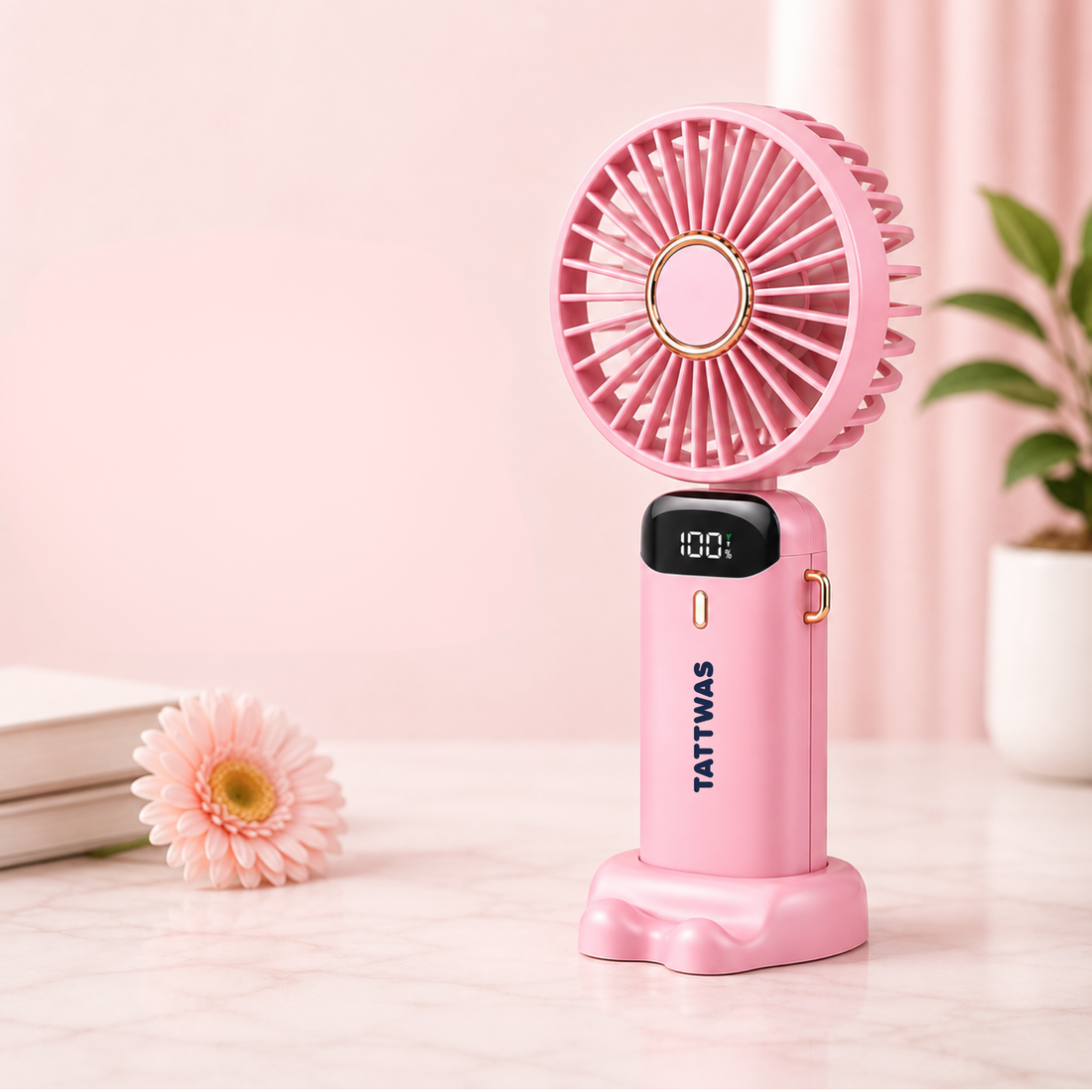

Hand Fan
Rs. 499
MRP Rs. 699
28% OFF
Selling fast
4.7/5
Rated by 176 customers
✓ 5-speed airflow, from gentle to strong
✓ 1800 mAh USB rechargeable · battery % on the display
✓ Fold-out stand for hands-free use
Choose your pack
VISA
UPI
RuPay
G Pay
100% Secure Checkout
✓ Dispatched in 1–2 business days
✓ Metro delivery in 3–5 business days
✓ Arrived damaged? We replace it
✓ Cash on Delivery available in select pin codes

Hand Fan
Rs. 499
MRP Rs. 699
28% OFF
Why a portable hand fan
Breathlessness is a feeling. That’s why a fan can touch it.
Breathlessness — clinically, dyspnoea — is not the same thing as low oxygen. It is a sensation your brain assembles from many signals: how hard your breathing muscles are working, what your chemoreceptors report, and what your airways and face are telling you. When those signals disagree, the brain produces the alarming feeling of not getting enough air, and it can do this while your oxygen levels sit perfectly normal.
That gap is why breathlessness is so hard to treat. A large double-blind trial found that in people who were not hypoxaemic, supplemental oxygen relieved breathlessness no better than ordinary room air. Opioids help some people but bring sedation and dose limits. For many patients the medicine cabinet runs out of answers well before the symptom does.
So palliative care researchers went looking for something that acts on the perception rather than the plumbing. A fan turned out to be it.
| Approach | The catch |
|---|---|
| Supplemental oxygen | No better than room air when oxygen levels are already normal. |
| Opioids | Effective for some, but sedation, constipation, dose ceilings. |
| Breathing techniques | Genuinely useful, but need training and practice. |
| Fan to the face | Cheap, immediate, portable — and does not raise oxygen. |
Where the observation came from
In 1987, researchers induced breathlessness in healthy volunteers and directed cold air at their cheeks. The sensation eased — and air directed at the leg did not do the same. The finding sat in the literature for two decades before a Cambridge palliative care team tested it in real patients. In 2010 they ran the trial. It held up.
🌬️
Eases the feeling of breathlessness
Demonstrated in a randomised crossover trial and repeated across multiple countries and patient groups.
⏱️
Works within minutes, drug-free
Core trials used sessions of about five minutes. No adverse effects were attributed to fan use.
🎯
Aimed, not just switched on
Direction is the active ingredient. The same fan pointed at a leg did nothing measurable.
And the thing it does not do
A portable hand fan does not raise your blood oxygen level. Every trial in this dossier measured the sensation of breathlessness — not oxygen saturation. Room air is about 21% oxygen whether or not a fan is moving it. If your oxygen is genuinely falling, that is a medical emergency and needs care immediately, not a fan.
How it works
Why the face specifically — not the arm, not the leg.
The trigeminal nerve is the face’s primary sensory nerve. It has three branches, and the second and third — V2, the maxillary branch, and V3, the mandibular branch — supply the cheeks, nose, upper lip, chin and jaw. Airflow and cooling across exactly this territory appears to send a signal that changes how the brainstem interprets respiratory effort. It is similar in spirit to the mammalian diving reflex, which is likewise triggered by cold stimulation of the face.

Fig. 1 — The facial zone that matters. Illustrative overlay on a photograph — not a medical scan, and nerve paths are indicative rather than anatomically exact. Airflow across the V2/V3 trigeminal territory is the specific target used in every clinical trial cited in this dossier. V1, the forehead and eye branch, is not the target.
What the 2023 mechanism work added
Two scoping reviews in Respiratory Physiology & Neurobiology examined what happens upstream. Across animal and human studies, increased trigeminal nerve activity was associated with reduced measures of inspiratory neural drive — the central command that makes breathing feel effortful. A companion review found trigeminal stimulation altered activity in the brain regions involved in processing breathlessness. Together they give the 1987 observation a plausible neural address rather than leaving it as an unexplained trick.
CN Vthe trigeminal nerve — cranial nerve five, the face’s primary sensory nerve
2 of 3branches involved: V2 and V3, not V1
Reflex-levelthe effect is proposed to act below conscious control, at the brainstem
The exact technique from the research
Point it at your face.
📏
STEP 1
Hold it close
About 15–20 cm from your face — close enough that you clearly feel airflow on your skin. Hold it, or use the stand at the same distance.
🎯
STEP 2
Aim at nose and mouth
Across your cheeks, nose and upper lip — the V2/V3 territory. Not the forehead, neck or chest.
⏱️
STEP 3
Give it a few minutes
Trials used roughly five-minute sessions. The effect builds quickly and does not need prolonged use.
🤝
STEP 4
One tool among several
Pair it with prescribed breathing techniques and medication. A complement to your treatment plan, never a replacement.
Benefits backed by research
Four claims. Four citations. Nothing else.
01Direction at the face — not merely airflow — is what produces the effect
The 2010 Cambridge crossover trial gave every one of fifty patients both conditions: the same fan aimed at the face, and aimed at the leg. Only the face condition produced a significant reduction in breathlessness score (P = 0.003).· Read source →
02The finding survives independent pooling
Two separate 2019 systematic reviews reached compatible conclusions. An exploratory review and meta-analysis in Palliative Medicine concluded that airflow relieves chronic breathlessness in advanced disease. A review of ten studies in the Journal of Pain and Symptom Management found the majority showed clinical benefit from facial fan therapy. A 2022 meta-analysis added cardiorespiratory and cancer populations.· Read source →
03It has been tested beyond palliative cancer care
A 2021 mixed-methods pilot in Scientific Reports tested a portable hand fan over two weeks in fibrotic interstitial lung disease. A 2017 study examined how patients fold the fan into self-management day to day. A 2025 randomised trial extended testing into respiratory failure. These are smaller and earlier-stage than the flagship trial, and should be read that way.· Read source →
04The mechanism is no longer purely hypothetical
2023 scoping reviews traced trigeminal stimulation to reductions in inspiratory neural drive and to altered activity in brain regions that process breathlessness. This is mechanistic evidence, not outcome evidence — it explains why rather than proving how much.· Read source →
The flagship trial — Galbraith et al., 2010
| Condition | Where airflow was directed | Result |
|---|---|---|
| Test condition | Face — across nose and mouth | Significant reduction in breathlessness score |
| Control condition | Leg — same fan, same duration | No meaningful change |
50participants with advanced disease and chronic breathlessness
5 mineach fan session, face and leg, in randomised order
VASmeasured on a validated 10 cm visual analogue scale
P = 0.003well below the conventional 0.05 threshold
How to read the strength of this evidence
The flagship trial is small by pharmaceutical standards, and blinding a fan is close to impossible. The counterweight is the crossover design, the independent replications, the concordant meta-analyses, and a control condition using the identical device pointed elsewhere. Unusually strong for a non-pharmacological comfort measure; unusually weak next to a licensed drug. Both are true at once.
The product & how to use it
Built for the exact zone the research points to.
Every clinical trial cited here used an ordinary portable hand fan, hand-directed at the face — no special medical device required. The Tattwas fan is built to make that gesture easy to repeat on purpose, every day.
🌀
5-speed airflow
Gentle through to strong, so you can find the setting where you clearly feel air on your cheeks without discomfort at close range.
🔋
1800 mAh, USB rechargeable
Battery percentage shown on the built-in display. No disposable batteries.
📐
Fold-out stand
Rest it on a table and it holds the aim itself — useful when a five-minute session is longer than you want to hold your arm up.
📄
Documented, not just claimed
This dossier ships with the product — seventeen linked sources, including the ones that limit what we can say.
| Tattwas Portable Hand Fan | A typical portable hand fan | |
|---|---|---|
| Airflow control | 5 discrete speeds | Often single speed or on/off |
| Hands-free use | Stand holds it at face height | Usually must be held throughout |
| Claims about oxygen | States plainly that it does not raise oxygen | Some marketing implies otherwise |
Comparison is against the general category of inexpensive portable hand fans, not any named product.
Check with your doctor first if
You have diagnosed trigeminal nerve disease or damage — several trials excluded this group.
You have significant peripheral vascular disease, or take beta-blockers.
Your breathlessness is new, sudden or severe. That needs medical evaluation, not a fan.
Good practice, every time
Keep using prescribed inhalers, oxygen or medication exactly as directed.
Treat this as symptom comfort, not diagnosis or treatment.
Seek care immediately for sudden severe breathlessness, chest pain or confusion.
The Tattwas Portable Hand Fan is a wellness and comfort accessory, not a medical device. It is not intended to diagnose, treat, cure or prevent any disease, and it does not raise blood oxygen levels. If you experience sudden, severe or worsening breathlessness, seek emergency medical care immediately. If you manage a chronic respiratory or cardiac condition, use this alongside — never in place of — your prescribed treatment plan.
The evidence
Every superscript in this dossier points to a numbered entry below. DOIs are linked wherever they exist; print-era references are given in full.
Foundational research & mechanism. 1. Schwartzstein RM, Lahive K, et al. (1987). Cold facial stimulation reduces breathlessness induced in normal subjects. American Review of Respiratory Disease, 136(1):58–61. 2. Aucoin R, Lewthwaite H, et al. (2023). Impact of trigeminal and/or olfactory nerve stimulation on measures of inspiratory neural drive. Respiratory Physiology & Neurobiology, 311:104035. 3. Aucoin R, Lewthwaite H, et al. (2023). Impact of trigeminal nerve and/or olfactory nerve stimulation on activity of human brain regions involved in the perception of breathlessness. Respiratory Physiology & Neurobiology, 311:104036.
Core clinical trials. 4. Galbraith S, Fagan P, et al. (2010). Does the use of a handheld fan improve chronic dyspnea? J Pain Symptom Manage, 39(5):831–838. 5. Bausewein C, Booth S, et al. (2010). Effectiveness of a hand-held fan for breathlessness. BMC Palliative Care, 9:22. 6. Booth S, Galbraith S, et al. (2016). The importance of the feasibility study. Palliative Medicine, 30(5):504–509. 7. Kako J, Morita T, Yamaguchi T, et al. (2018). Fan therapy is effective in relieving dyspnea in patients with terminally ill cancer. J Pain Symptom Manage. 8. Luckett T, Phillips J, Johnson MJ, et al. (2017). Contributions of a hand-held fan to self-management of chronic breathlessness. European Respiratory Journal, 50:1700262. 9. Khor YH, Saravanan K, Holland AE, et al. (2021). A mixed-methods pilot study of handheld fan for breathlessness in interstitial lung disease. Scientific Reports, 11:6874. 10. Yue D, Xie X, Chen G, et al. (2025). Handheld fans for dyspnoea in respiratory failure. BMJ Supportive & Palliative Care, 15:231–236.
Systematic reviews & meta-analyses. 11. Swan F, Newey A, et al. (2019). Airflow relieves chronic breathlessness in people with advanced disease. Palliative Medicine, 33(6):618–633. 12. Qian Y, Wu Y, Rozman de Moraes A, et al. (2019). Fan therapy for the treatment of dyspnea in adults: a systematic review. J Pain Symptom Manage, 58(3):481–486. 13. Tsai JJ, Chen KH, Fang HF, Huang TW. (2022). Relieving from breathlessness in the wind. American Journal of Hospice & Palliative Care, 39(8):977–985.
Context, cooling & thermoregulation. 14. Abernethy AP, McDonald CF, Frith PA, et al. (2010). Effect of palliative oxygen versus room air in relief of breathlessness in patients with refractory dyspnoea. The Lancet, 376(9743):784–793. 15. Jay O, Cramer MN, Ravanelli NM, Hodder SG. (2015). Should electric fans be used during a heat wave? Applied Ergonomics, 46(Pt A):137–143. 16. Morris NB, English T, et al. (2019). The effects of electric fan use under differing resting heat index conditions. Annals of Internal Medicine. 17. Gagnon D, Romero SA, Cramer MN, et al. (2017). Age modulates physiological responses during fan use under extreme heat and humidity. Medicine & Science in Sports & Exercise, 49(11):2333–2342.
Founder image
From our founder
“Whatever you see, touch, eat or drink… has an energy, and that energy is made from only 5 elements.”
Vishall
Founder, Tattwas
Founder, Tattwas
Good to know
FAQ
Everything you need before adding to basket.
Does it raise my oxygen level? +
No. Every trial cited on this page measured the sensation of breathlessness — not oxygen saturation. Room air is about 21% oxygen whether or not a fan is moving it. If your oxygen is genuinely falling, that is a medical emergency and needs care immediately, not a fan.
Where exactly should I point it? +
About 15–20 cm from your face, across your cheeks, nose and upper lip — the V2/V3 trigeminal territory. Not the forehead, neck or chest. Direction is the active ingredient: in the flagship trial the same fan pointed at a leg did nothing measurable.
How long is a session? +
Trials used roughly five-minute sessions. The effect builds quickly and does not need prolonged use.
How is it powered, and how do I charge it? +
A 1800 mAh built-in battery, recharged over USB. Battery percentage is shown on the built-in display. No disposable batteries.
How many speeds does it have? +
Five. Gentle through to strong, so you can find the setting where you clearly feel air on your cheeks without discomfort at close range.
Can I use it hands-free? +
Yes. The fold-out stand rests it on a table and holds the aim itself — useful when a five-minute session is longer than you want to hold your arm up.
Should I stop my usual medication or inhaler? +
No. Keep using prescribed inhalers, oxygen or medication exactly as directed. Pair the fan with prescribed breathing techniques and medication — a complement to your treatment plan, never a replacement.
Who should check with a doctor first? +
Anyone with diagnosed trigeminal nerve disease or damage — several trials excluded this group — significant peripheral vascular disease, or who takes beta-blockers. Breathlessness that is new, sudden or severe needs medical evaluation, not a fan.
Hand Fan ·
Rs. 499
MRP Rs. 699
28% OFF
★★★★★ 4.7/5
Ancient elements, everyday wellness
VISA
Mastercard
UPI
RuPay
COD