

Product dossier · A half-degree matters · Measured, not guessed
Not warm. Not hot. Exact.
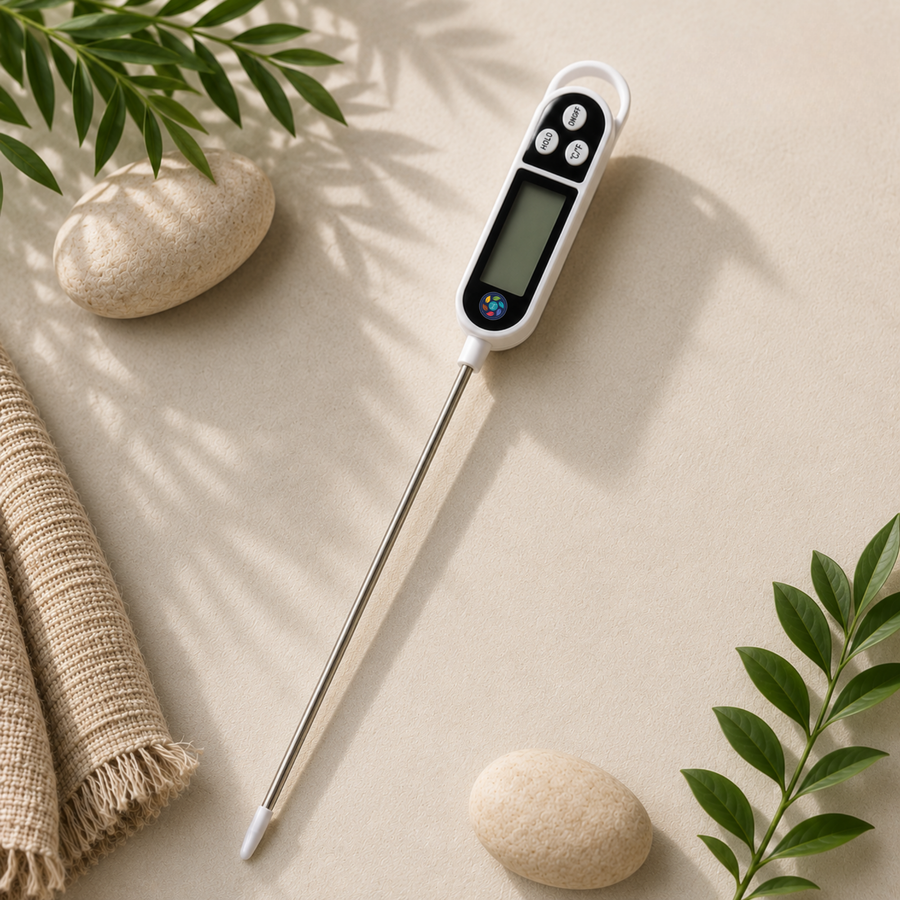
“Feels about right” isn’t a safety standard. The Tattwas Digital Precision Thermometer gives you the actual number — for bath water, baby formula, and every warm-water routine where a few degrees change the outcome more than most people expect.
Tattwas Digital Precision Thermometer · Thermistor Probe · ±0.5°C Accuracy · 8–10s Response · Backlit LCD · °C/°F Toggle · HOLD Function · NIST-Traceable Calibration
Rs. 199
MRP Rs. 299
33% OFF
Add to Basket
±0.5°CNIST-traceable accuracy
8–10sto a stable, settled reading
°C/°Fone-button unit toggle
Why this dossier exists
The physiology behind warm-water response is more specific than most people ever see — this book walks through the actual thresholds, not just a reminder to “check the water first.”
02 · Key benefits
Key benefits, before you scroll further.
Everything below is backed by the calibration and physiology data later in this dossier — this is the short version.
⏱
Instant, stable reading
8–10 seconds to a settled number — no more guessing whether it’s “done.”
🎯
±0.5°C accuracy
NIST-traceable calibration chain behind the number — not just a spec on the box.
🏠
One tool, whole household
Bath water, baby formula, and warm-water comfort routines — same probe, same standard.
🔄
°C / °F switchable
One button toggles units — useful across recipes, routines, and regions.
💡
Backlit, easy-read display
Legible at bath-side or stove-side without squinting or extra light.
🧼
Built for repeat use
Wipe-clean probe, HOLD function, and a simple ice-point check to catch sensor drift.
03 · Why digital thermometer
“Feels about right” isn’t a safety standard.
Water temperature doesn’t produce a smooth, proportional response in the body — it’s a narrow band where a handful of degrees changes outcomes noticeably, in minutes, not a gradual slide.
A hand test tells you “warm” or “hot.” It cannot reliably tell you 40°C from 45°C — and that’s exactly the range where the body’s actual response (blood flow, sweating, comfort) shifts the most per degree.
The margin, in numbers
8°Cskin temperature rise shown to produce a >10-fold increase in skin blood flow
40–42°Ccommonly used comfortable range for a warm foot or leg bath
±0.5°Ctypical accuracy of a properly calibrated digital instant-read thermometer
This dossier makes that case with the actual numbers, not just general advice to “check the water first” — because the specific thresholds are more useful, and more interesting, than the general reminder.
04 · How it works
How it actually measures heat.
Three steps, from probe tip to the number on the screen.
1
Probe tip senses heat
A ceramic thermistor in the tip changes electrical resistance predictably as temperature changes.
2
Signal becomes a number
Electronics translate that resistance into a temperature reading — a measured property, not a guess.
3
Checked against a standard
Each reading traces back to a NIST-referenced calibration, not just factory guesswork.
| Technology | How it works | Typical use |
|---|---|---|
| Thermistor | Ceramic semiconductor changes resistance predictably with temperature | Instant-read probes, liquids and water |
| Thermocouple | Two metals joined at a point generate a small voltage proportional to temperature | Oven-safe probes, wider ranges |
Tattwas uses a thermistor probe — the standard choice for fast, accurate liquid readings close to the tip. Both technologies can be calibrated for accuracy; the electronics translate a physical, measurable property into a number, rather than relying on a person’s sense of “hot.”
05 · Benefits backed by research
Benefits, backed by the actual research.
The short version of each finding, with sourcing — the full reference list follows in section 10.
| The number | The finding |
|---|---|
| >10× BLOOD FLOW |
An 8°C skin temperature rise → >10× more skin blood flow. Not a gradual increase — a specific, well-measured threshold effect. Song et al. (1989); Charkoudian, Mayo Clinic Proceedings (2003). |
| 2–3× PER 10°C |
Q10 ≈ 2–3: the body’s metabolic rate roughly doubles per 10°C. Measured directly via oxygen consumption (Q10 ≈ 2.1 average, individual variation up to 8). Kampmann & Bröde (2015); reviewed in Frontiers in Physiology (2019). |
| ±0.2–0.5°C ACCURACY |
Calibrated instruments hold ±0.2–0.5°C across a working range. Checked at multiple points (0°C, 25°C, 50°C, 100°C) against a NIST-referenced standard, with deviation documented, not hidden. ISO/IEC 17025 methodology. |
| 37–38°C INFANT USE |
Infant thermoregulation and skin sensitivity are still maturing — a meaningful reason bath and formula water get an exact target (37–38°C), not “warm.” Pediatric water-temperature guidance; developmental thermoregulation literature. |
On Q10: the source flags this itself — 2–3 is rigorously measured for metabolic rate and oxygen consumption, not isolated sweat-gland output specifically. Kampmann & Bröde (2015) measured Q10 ≈ 2.1 via oxygen uptake in 11 acclimated men, with individual variation up to 8.
06 · Why choose Tattwas
Why choose Tattwas.
| Spec | Detail |
|---|---|
| Sensor type | Thermistor probe |
| Accuracy | ±0.5°C across the working range |
| Response time | Approx. 8–10 seconds to a stable reading |
| Display | Backlit LCD, °C/°F toggle, HOLD function |
| Calibration | NIST-traceable, multi-point checked |
| Care | Wipe-clean probe · avoid submerging display housing unless fully waterproof-rated |
How it compares
| Tattwas Digital | Hand / elbow test | Basic glass thermometer | |
|---|---|---|---|
| Accuracy | ±0.5°C | Not measurable — “warm” or “hot” only | Varies, often ±1–2°C, harder to read precisely |
| Speed | 8–10 seconds | Instant, but not a real reading | Slow drift to a stable reading |
| Readability | Large backlit digital display | N/A | Small markings, no backlight |
| Consistent across uses | Yes — same calibrated sensor every time | No — subjective, varies by person | Yes, but fragile and slower |
Category comparisons, not claims about specific competitor products.
Rs. 199
MRP Rs. 299
33% OFF
Add to BasketFree shipping on orders over ₹499 · ships in 2–3 business days
07 · How to use
Technique matters as much as the instrument.
1
Don’t touch the sides
Keep the probe tip away from the container walls or bottom — you’ll read the container’s temperature, not the water’s.
2
Wait for stability
Let the reading settle for the full response time (8–10 seconds) before recording it — early readings drift.
3
Check in the middle
For a bath or basin, measure mid-depth, mid-container — surface and bottom can differ by several degrees.
4
Re-check at point of use
Water cools in transit — test at the tap, then again where the water will actually touch skin.
Care
- After each use. Wipe the probe clean and dry before storing.
- Periodically. Ice-water check: 0°C in a stirred ice-water mix confirms the sensor hasn’t drifted.
- Always. Avoid submerging the display housing — probe only, unless rated fully waterproof.
09 · Frequently asked
Frequently asked questions.
How accurate is the Tattwas thermometer, really?
±0.5°C across its working range, checked against a NIST-referenced standard at multiple points — not a single-point factory guess.
How do I know the sensor hasn’t drifted over time?
Run a periodic ice-water check: a stirred ice-water mix should read 0°C. If it’s noticeably off, the probe may need recalibration or replacement.
Is it safe to use for a baby’s bath water or formula?
Yes — this is one of the most common uses. Target 37–38°C for infant bath water, and test before every bath, not just once. It’s a measurement tool, not a medical device, and doesn’t diagnose or treat anything.
Is the display waterproof?
The probe is designed for liquid contact; avoid submerging the display housing unless your unit is rated fully waterproof.
What if my thermometer arrives damaged or faulty?
If the item arrives damaged or not functioning, report it within 2 days of delivery for a return. Replacements are available within 14 days of delivery for eligible items.
Can I use it for cooking, not just bath water?
Yes — the same thermistor probe and ±0.5°C accuracy apply to any liquid, including recipes that call for a specific water or milk temperature. °C/°F toggle included.
10 · Scientific evidence
Scientific evidence.
Condensed here by topic.
1Thermoregulation physiology
Skin blood flow response to local skin temperature: Song & Charkoudian (reviewed in RF-energy computational dosimetry literature); Charkoudian N. (2003), Mayo Clinic Proceedings, 78(5):603–612. Sweat-rate-to-core-temperature relationship: Kuno (1956), Benzinger (1959) foundational work; Nadel et al. on skin temperature’s modulating effect on the sweating threshold. Direct exercise measurement: sweat rate rose ~0.04 L/hr per °C of air temperature, controlled crossover trial.
2The Q10 temperature coefficient
Heat Acclimation Does Not Modify Q10 and Thermal Cardiac Reactivity, Frontiers in Physiology (2019) — reviewing Chaui-Berlinck et al. (2002), Seebacher et al. (2015), IUPS Thermal Commission (2003). Kampmann & Bröde (2015): Q10 ≈ 2.1 measured via oxygen uptake, 11 acclimated men. Werner & Buse (1988); Fiala et al. (2012): Q10 = 2 applied in established human thermoregulation models.
3Infant & sensitive-use water temperature
Pediatric bathing and formula-preparation water temperature guidance — commonly cited body-temperature (37–38°C) target range. Developmental differences in infant thermoregulation and skin sensitivity relative to adult skin.
4Calibration & accuracy standards
NIST-traceable calibration methodology — ISO/IEC 17025 accredited laboratory practice, multi-point verification (0°C, 25°C, 50°C, 100°C). ANSI Z540 and MIL-STD-45662A — calibration compliance standards referenced across EPA and GLP/GMP-regulated testing. ITS-90 International Temperature Scale — the reference scale underlying traceable calibration.
Sourcing note. The source dossier names these bodies of work by author, year and standard, but publishes no direct links or DOIs — none are invented here. It also groups the evidence by topic rather than reporting each study’s design, sample size or effect size individually.
Infant bath water and formula
Target 37–38°C for infant bath water, and test before every bath, not just once. Infant thermoregulation and skin sensitivity are still maturing, which is why the target is an exact number rather than “warm.”
Waterproofing, and checking for drift
The probe is designed for liquid contact; avoid submerging the display housing unless your unit is rated fully waterproof.
Run a periodic ice-water check — a stirred ice-water mix should read 0°C. If it’s noticeably off, the probe may need recalibration or replacement.
11 · Shipping & returns
Shipping and returns.
| Detail | |
|---|---|
| Delivery | Orders ship within 2–3 business days, with delivery in around 7 days. |
| Shipping cost | Free shipping on orders over ₹499. |
| Returns | Returns accepted if the item arrives damaged or not functioning — reported within 2 days of delivery. |
| Replacements | Replacement available within 14 days of delivery for eligible items. |
Not warm. Not hot. Exact.
The actual number — for bath water, baby formula, and every warm-water routine where a few degrees change the outcome more than most people expect.
Add to BasketThe Tattwas Digital Precision Thermometer is a measurement instrument, not a medical device. It is not intended to diagnose, treat, cure, or prevent any disease. Warm-water use recommendations in this dossier describe comfort and safety ranges only.