

Product dossier · Evidence-based, not oversold
Lemon reacts. Steel doesn’t.
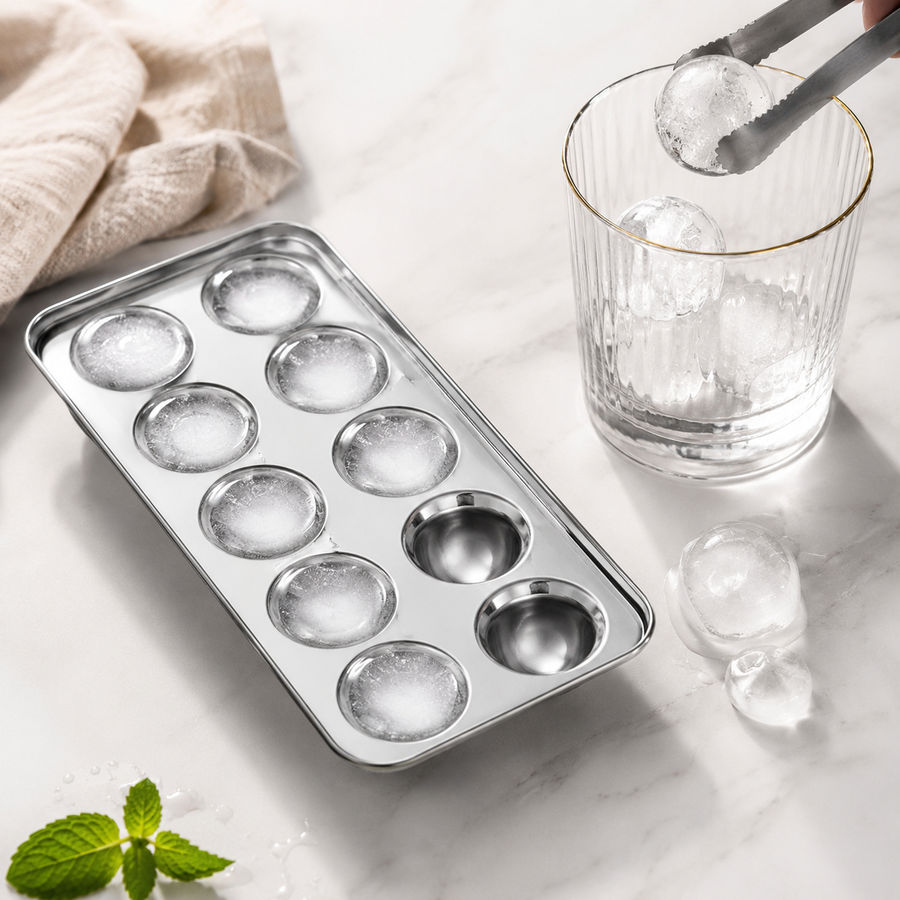
The Tattwas Stainless Steel Ice Tray exists because the material holding your ice isn’t neutral — plastic sheds, aluminum reacts with acid, and steel does neither. That matters most for something this acidic: a ginger, turmeric, lemon, and black-pepper morning shot.
Tattwas Stainless Steel Ice Tray · 10-Cell · Small-Shot Format · Food-Grade 304 / 18-8 Steel · Won’t React With Acid · Dishwasher Safe
Rs. 1,799
MRP Rs. 2,599
30% OFF
Add to Cart
5.1 mgaluminum leached per 100 g when food is cooked with lemon juice
10,000estimated annual microplastic particles from packaged ice cubes
Inertstainless steel’s actual behavior toward acids like citric acid
01 · Key benefits
Four reasons it earns its place.
Not a longer list of adjectives — a short list of things that are actually true, and measurable, about the material in your freezer.
🍋
Inert to acids
Won’t react with lemon or citric acid, even across repeated freeze–thaw cycles — unlike aluminum’s measurable leaching.
🧊
No microplastic pathway
Steel doesn’t turn brittle or shed particles from cold cycling — unlike flexible plastic trays that flex and abrade.
🌿
No odor, no stain
A non-porous surface. Turmeric’s curcumin permanently stains plastic yellow; it doesn’t stain steel.
🔩
Food-grade 304 (18/8)
The same standard used in commercial kitchens, food-processing equipment, and surgical instruments.
🚿
Dishwasher safe
No degradation from repeated heat or detergent exposure. Hand-wash only if you want to extend its life further.
📐
Evidence-based, not oversold
Every claim here is tied to a published study — and where the science is debated, we say so plainly.
02 · Why the material matters
What you freeze it in isn’t neutral.
An ice tray looks like the most inert object in a kitchen — plastic, metal, whatever’s on hand. It isn’t.
Freezing is a repeated mechanical and thermal stress cycle, and the material holding your ice responds to that stress differently depending on what it’s made of. This matters more, not less, for a tray used to freeze something acidic: lemon juice sits around pH 2 — acidic enough to be genuinely reactive with certain metals.
🥤
Plastic
Can shed micro- and nanoplastics as repeated freeze–thaw cycles make certain plastics brittle, and flexes and abrades with every twist.
Sheds particles🥫
Aluminum
Measurably reacts with acidic ingredients like citric acid — the single most relevant fact for a recipe built specifically around lemon.
Reacts with acid🔗
Stainless Steel
Chemically inert to both failure modes. The reason it’s the standard material in food-grade and commercial-kitchen equipment.
Doesn’t reactThe next pages go through what’s actually measured for each material — not “steel is better” branding, but the specific studies behind every claim.
03 · How it works
A thin oxide layer that heals itself.
Food-grade stainless steel (typically 304 / 18-8) resists acid corrosion for a specific chemical reason — not a marketing one.
1
Chromium in the alloy
304 steel is roughly 18% chromium. At about 10.5%+ chromium, the alloy gains a special property.
2
A passive oxide film forms
Chromium reacts with oxygen to form a thin, invisible oxide layer across the entire surface.
3
The film self-repairs
Scratch it and it re-forms — the same passivation chemistry used in surgical instruments and food-processing equipment.
4
Acid can’t corrode it
That barrier is what keeps citric acid from reacting with the steel underneath, cycle after cycle.

The turmeric test — visible on your counter
There’s a simple confirmation of the same chemistry: turmeric’s curcumin is a well-known natural dye, famous for permanently staining plastic containers yellow. It does not stain stainless steel — precisely because steel isn’t porous or chemically reactive the way plastic surfaces are.
04 · Backed by research
The numbers, and where they come from.
Three findings do most of the work in this product’s case. Here they are with the actual sources — concise, with the full studies one page away.
| The number | Where it comes from |
|---|---|
| 178 MPS / LITRE |
Packaged ice cubes contained 19–178 microplastic particles per litre — modeling puts annual intake from ice alone at 490 to 10,000+ particles. Peer-reviewed study of 15 commercial ice brands, Mexico City — ScienceDirect (2022). |
| 5.1 MG / 100G |
Red cabbage cooked with lemon juice at pH 2.6 showed aluminum leaching of 5.1 mg per 100 g; acidic fruit juice boiled in aluminum reached 2.9–35 mg/kg. Aluminium-leaching studies — ScienceDirect & PubMed food-science literature. |
| 2000% — DEBATED |
A landmark 1998 study reported a 2000% increase in curcumin bioavailability when paired with 20 mg of black-pepper piperine (Shoba et al., Planta Medica). Honest caveat: a 2025 Amsterdam UMC crossover study found no benefit for the biologically active form. We include both sides — see section 08. |
Every figure above is fully cited in the Scientific Evidence section below.
05 · Why choose Tattwas
Compared honestly, material by material.
| Property | Plastic | Aluminum | Stainless Steel |
|---|---|---|---|
| Reacts with acidic ingredients (lemon, citric acid) | No, but can leach additives | Yes — measurable leaching | No — chemically inert |
| Degrades under repeated freeze–thaw cycling | Can become brittle, shed particles | Minimal | No measurable degradation |
| Retains odors / flavors between uses | Common with porous or scratched plastic | Minimal | Non-porous, doesn’t retain odor |
| Standard in food-service equipment | Limited | Limited (mainly non-acidic cooking) | Industry standard |
We don’t upsell steel you don’t need
Food-contact grades are defined by exact chromium and nickel percentages — that’s what “18/8” means (18% chromium, 8% nickel). Grade 304 (18/8) is what nearly every reputable steel ice tray uses, and it’s genuinely sufficient for repeated citric-acid contact. 316 is a real upgrade only in extreme, prolonged, high-salt conditions — not this one.
- Food-Grade 304 / 18-8
- Acid-Resistant Surface
- Dishwasher Safe
- Zero Plastic Contact
06 · How to use
One tray. A two-minute morning habit.
Sized for small, potent portions rather than standard water-cube volume — right for a concentrated ginger-lemon-pepper shot, not a full glass of iced tea.
1
Blend the base
Fresh ginger and turmeric, lemon juice, a pinch of black pepper, diluted with water into a smooth, pourable paste.
2
Freeze in steel
Pour into the tray and freeze — the acidic mix never touches plastic or aluminum at any stage.
3
Drop into hot water
One or two cubes dissolved into a cup of hot — not boiling — water each morning.
4
Use within weeks
Compounds hold up well frozen, but potency still fades gradually with long storage.
Care
- After each use. Rinse and dry, or run it through the dishwasher.
- Weekly. A quick vinegar-water soak keeps the surface free of mineral buildup from hard water.
- Always. Let cubes sit a few seconds at room temperature before twisting to release.
To release a cube
A gentle twist of the tray, or a brief warm-water rinse on the underside, frees the cubes cleanly — no cracking or prying needed.
07 · Trust & assurance
Built to be believed, not just bought.
Verified customer reviews will appear here as our first buyers share them. Until then, here’s what already stands behind this tray — the published science, and the promises we’re willing to put in writing.
From the research
Depending on the type of plastic, freezing might make it brittle and result in the release of nano- and microplastics. Martin Wagner, PhD — Associate Professor of Biology, Norwegian University of Science and Technology. The scientist’s own words on why the material matters — not a paid endorsement.
Our promises to you
🔩
Food-grade 304, guaranteed
Genuine 304 / 18-8 stainless — the same standard used in commercial kitchens and surgical instruments.
📦
Dispatched in 3–7 days
Tracked from the moment it ships, so you always know where your order is.
🚿
Dishwasher safe for life
No coating to wear off, no plastic to degrade — it cleans up the same on day 500 as day one.
📐
Every claim, cited
Each benefit on this page traces to a published study — and where the science is debated, we say so.
08 · Frequently asked
Straight answers, including the caveats.
Does freezing destroy the ginger, turmeric, or lemon compounds?
Largely no. Freezing is one of the gentler preservation methods — far less destructive than boiling. Gingerols and piperine are freeze-stable, and curcumin is comparatively stable when frozen; vitamin C is moderately sensitive. Storage time matters more than the freezing itself — a cube used within a few weeks retains more than one left for months.
What grade of steel is it?
Food-grade 304 (18/8) — 18% chromium, 8% nickel. It’s the global food-safety standard, used in the large majority of quality stainless kitchenware, and genuinely sufficient for repeated acid contact.
Is it dishwasher safe? Will turmeric stain it?
Yes to the dishwasher — hand washing is recommended only to extend longevity. And no, turmeric won’t stain it: steel is non-porous and non-reactive, so curcumin doesn’t bond to it the way it does to plastic.
How do I get the cubes out?
A gentle twist of the tray, or a brief warm-water rinse on the underside. Letting the cubes sit a few seconds at room temperature first makes release effortless.
Is it safe for everyone?
It’s a kitchen accessory, not a medical device. Check with your doctor first if you take blood-thinning medication (ginger has mild anticoagulant activity), have acid reflux or a sensitive stomach, or have a known nickel or metal sensitivity.
Is the “2000% curcumin” claim actually true?
The original 1998 study reported it, and it’s one of the most-cited findings in nutrition. But a 2025 independent crossover study found no benefit for the biologically active form of curcumin. We present both rather than overselling a 27-year-old number as settled — that’s the standard we hold every claim to.
09 · Scientific evidence
Every claim, with its scientific evidence.
These are the studies behind each claim.
Material Science — Plastic & Microplastics
1First evidence of microplastic contamination in packaged food ice cubes
ScienceDirect (2022) — 15 commercial ice brands, Mexico City; 19–178 MPs/L.
2Freeze-related plastic brittleness and micro/nanoplastic release
Wagner M, PhD, Norwegian University of Science and Technology.
3Microplastic release from single-use plastic beverage cups
NCBI/PMC — temperature- and time-dependent release from plastic surfaces.
Material Science — Aluminum Leaching
4Leaching of aluminium from cooking pans and food containers
ScienceDirect — red cabbage with lemon juice, pH 2.6, 5.1 mg Al/100g.
5Leaching of aluminium from dishes and packages
PubMed — acidic fruit juice leaching 2.9–35 mg/kg.
6Assessing leaching of hazardous elements from cookware
NCBI/PMC (2023) — comparative aluminum vs. steel leaching data.
Ginger, Turmeric & Black Pepper
7Zingiber Officinale: The Antiarthritic Potential of a Popular Spice
NCBI/PMC — ginger’s anti-inflammatory activity, clinical and preclinical review.
8A Systematic Review of Piperine as a Bioavailability Enhancer
ResearchGate — piperine’s established absorption-enhancing role.
9Influence of piperine on curcumin pharmacokinetics
Shoba G et al. (1998). Planta Medica, 64(4):353–356.
10Independent crossover study — no piperine benefit on unconjugated (active) curcumin
Kroon PC et al. (2025), Amsterdam UMC.
11Synergistic effects of black pepper with other spices
IJPREMS — piperine/gingerol combined COX-2 inhibition mechanism.
Stainless Steel Grade Standards
12Food-grade stainless steel composition standards (304/18-8, 316/18-10, 430/18-0)
Chromium/nickel percentages and corrosion-resistance properties; multiple materials-science and nickel-industry sources.
10 · Shipping & care
Dispatched in 3–7 days.
🚚
Delivery — 3–7 days
Orders are dispatched and delivered within 3–7 business days. You’ll receive tracking once your tray ships.
🎁
In the box
One Tattwas Stainless Steel Ice Tray — 10-cell, small-shot format, food-grade 304 / 18-8 stainless steel. Care: dishwasher safe; hand wash and a weekly vinegar-water soak for longevity.
Support
Questions about your order? Email connect@tattwas.com
Check with your doctor first
The Tattwas Stainless Steel Ice Tray is a kitchen accessory, not a medical device. If you take blood-thinning medication (ginger has mild anticoagulant activity), have acid reflux or a sensitive stomach, or have a known nickel or metal sensitivity, speak with your doctor before adopting the morning shot as a daily habit.
Lemon reacts. Steel doesn’t.
Evidence-based, not oversold — every claim on this page traces to a published study, and where the science is debated, we say so.
Order Your Tattwas Ice TrayThe Tattwas Stainless Steel Ice Tray is a kitchen accessory, not a medical device. It is not intended to diagnose, treat, cure, or prevent any disease. If you take blood-thinning medication or manage a digestive condition, speak with your doctor before adopting the morning shot as a daily habit.