

Product dossier · Mitti diya · Five-element lamp
One small flame. All five elements tended at once.
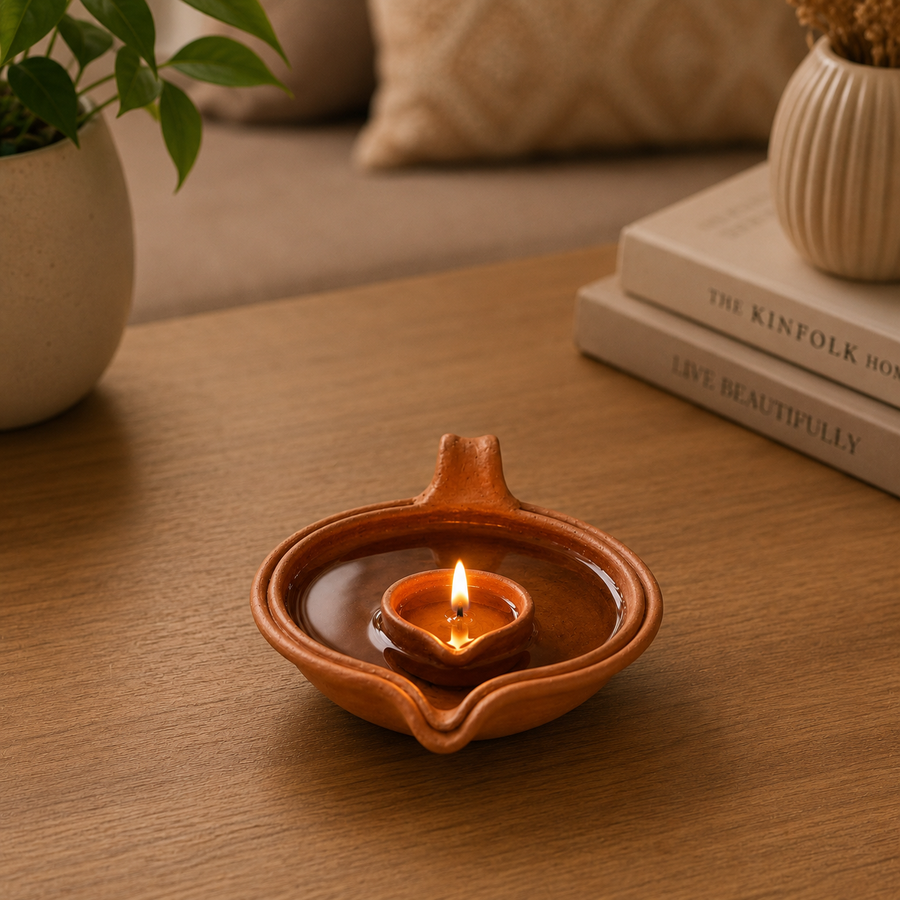
A diya inside a diya, made of mitti. Oil burns in the inner bowl, water fills the moat around it, and one flame joins all five elements.
Tattwas Panchabhutam Diya · Unglazed mitti · Inner oil diya in a water moat · Carry handle · Ghee, til or mustard oil · Cotton wick
Rs. 199
MRP Rs. 699
71% OFF
Add to Basket
5elements in one lamp: earth, water, fire, air and space
2–5 minof soft gazing, blinking freely, once a day at sunrise or dusk
9published sources behind this page
Why this dossier exists
What a flame, a daily ritual and a few still minutes can do, where the evidence stops, and how to light it safely. Each benefit names its study, its size and its limits. No study has tested this diya itself; these look at the practices it supports.
02 · Key benefits
What a few minutes by the flame can do
Four things you can reasonably expect, and four we won’t promise.
🪔
All five elements in one lamp
The clay is earth, the moat is water, the flame is fire, the air around it feeds it, and the open space between the bowls is space. Ayurveda calls these five the Panchamahabhuta.
Ayurvedic framework🔥
A calmer evening
In three studies of 226 adults, watching a fire with its natural sound lowered blood pressure, and more so the longer people watched. The fire was a video, not a diya.
Evolutionary Psychology, 2014👁️
Steadier focus
After one session of Trataka, gazing softly at a flame, 30 young men scored better on an attention test than after a control session. It was a small, short study.
J Tradit Complement Med, 2016💧
Drips stay in the moat
Oil that runs over the inner lip falls into the water, not onto your floor or puja thali. The water also keeps the base from heating the surface and stops ants reaching the oil.
Product designHow often, and when
2–5 minutesof soft gazing, blinking freely
Once a dayat sunrise or dusk, if you can
Any occasionpuja, meditation or festivals
What we won’t promise
A cure. No study has tested this diya, or any diya, as a treatment for any condition.
Purer air. Any flame gives off some smoke and fine particles. Light it in a ventilated room.
Better eyesight. Flame-gazing has been studied for attention and memory, not to correct vision.
Measured balance. The five elements are a traditional way of seeing. No test can measure them.
03 · Why Panchabhutam Diya?
The ritual is sound. The lamp was missing four elements.
Lighting a diya at dusk is one of the oldest habits in an Indian home, and it does feel good. But an ordinary diya holds only oil and a flame. Indian tradition describes us as made of five elements, and most of our day keeps us far from all of them.
| Ordinary diya | Panchabhutam Diya | |
|---|---|---|
| Elements | Brings together only earth, fire and air | All five elements meet in one lamp |
| Drips | Oil overflows onto the floor or thali | Water moat catches every drip |
| Handling | Hot clay sits directly on the surface | Handle to carry it for aarti |
Light that can affect the sleep hormone
8 luxlight that can affect the sleep hormone
Even light this dim, less than most table lamps give, can interfere with melatonin. Blue-rich LED and screen light at night does so most strongly. A small oil flame gives a low, warm, amber light instead. (Harvard Health Publishing, Blue light has a dark side.)
In the mind, the problem is no pause
Most evenings run from one screen to the next with no clear end to the day. Lighting a lamp at dusk gives the day an edge: a few minutes with nothing to do but tend water, oil and flame.
So we kept the flame and gave it all five elements.
04 · How it works
Water around. Oil within. Fire above.
The diya does one job. It holds a flame inside a ring of water, so all five elements are present the moment you light it.
1
Water · Jal
Fill the outer bowl about two-thirds with clean water, keeping it below the rim of the inner diya.
2
Oil, the fuel
Pour ghee, til or mustard oil into the inner diya and lay a cotton wick on its lip.
3
Fire · Agni
Light the wick. Oil climbs the cotton and burns as vapour at the tip, as a small steady flame.
4
Air and space
Air around the lamp feeds the flame, and the open space between the two bowls holds them all. The clay, earth, holds everything.
🏺
In the clay
Unglazed mitti is porous. It soaks up a little oil and darkens near the wick over time. Soaking the diya in water before first use slows this.
💧
In the moat
Water catches oil that spills over the lip, takes up heat from the inner bowl, and makes a barrier that ants will not cross to reach the oil.
🔥
In the flame
A small oil flame gives warm amber light, low in the blue light that most disturbs sleep hormones at night. Keep the wick short for a steady flame.
04 · How it works, continued
Five elements, one lamp
Where each element lives in the diya, what tradition links it to, and the small part you play in it each time you light the lamp.
| Element | In the diya | In tradition | Your part |
|---|---|---|---|
| Space AKASH |
The open space between the inner and outer bowl, which holds the other four. | The first and subtlest element; room for everything else to exist. Sense: hearing. | Sit in quiet for a few minutes with your phone out of reach. |
| Air VAYU |
The oxygen that feeds the flame. Without air, the diya cannot stay lit. | Movement and breath; the element of everything that flows. Sense: touch. | Breathe slowly while the flame burns, in a room with fresh air. |
| Fire AGNI |
The lit cotton wick on the inner diya’s lip, burning oil as a small flame. | Light, warmth and transformation; the element of digestion and clarity. Sense: sight. | Rest your gaze softly on the flame, the practice called Trataka. |
| Water JAL |
The moat between the two bowls, catching drips and cooling the base. | Fluidity and nourishment; the element that binds and carries. Sense: taste. | Pour in fresh water each day before you light the lamp. |
| Earth PRITHVI |
The hand-shaped mitti body of both bowls and the handle. | Stability and structure; the densest element, which holds form. Sense: smell. | Care for the clay with plain water, and carry it by its handle. |
A framework, not a measurement
In Ayurveda and naturopathy, health is described as the five elements in balance. That is a traditional way of seeing the body and the world. The diya brings all five into one daily ritual; it does not measure or change them. (Shalini, Shradha & Nivetha, Indian J Integr Med, 2025, review article.)
05 · Benefits backed by research
What the research supports
Each benefit names its study, its size and its limits. No study has tested this diya itself; these look at the practices it supports.
| The number | The finding | Source |
|---|---|---|
| 226 adults RANDOMISED CROSSOVER, 3 STUDIES |
A calmer body by the fire. Watching a fire with its natural sound lowered blood pressure, and the drop grew with longer viewing. The fire was shown on a screen. | Lynn, Evol Psychol, 2014 |
| 30 adults REPEATED MEASURES, 2 SESSIONS |
Sharper attention after flame-gazing. Stroop test scores were better after a Trataka session than after a control session. All participants were young men, tested once. | Raghavendra & Singh, J Tradit Complement Med, 2016 |
| 41 adults REGISTERED TRIAL, CTRI INDIA |
Working memory after Trataka. Memory span scores were higher after a Trataka session than after eye exercises or at baseline. Participants already practised yoga. | Swathi et al., Front Psychol, 2021 |
| Ritual LAB EXPERIMENTS, NO DIYA TESTED |
A short ritual eases nerves. People who performed a brief ritual before a stressful task had lower heart rates, felt less anxious and performed better. Calling it a ritual mattered. | Brooks et al., OBHDP, 2016 |
| 10–100× LAB CHAMBER TEST, CANDLES NOT DIYAS |
A small flame smokes far less than incense. Candles released 10 to 100 times less fine particle matter than incense or mosquito coils. Less is not none, so keep the room ventilated. | Ongwandee & Pipithakul, Appl Environ Res, 2013 |
Works well alongside the diya
- A few minutes of meditation. A review of 47 randomised trials found meditation programmes gave small to moderate reductions in anxiety, depression and pain. They were not better than other active treatments. (Goyal et al., 2014)
- Dim, warm light after dark. Blue light at night suppresses melatonin more than other light. Harvard’s advice is dim red light in the evening and no bright screens two to three hours before bed. (Harvard Health)
06 · Why choose Tattwas?
Why choose the Panchabhutam Diya
1
Inner diya
Holds the oil. Its pinched lip keeps the wick in place.
2
Water moat
The outer bowl around it. Catches drips and keeps the base cool.
3
Handle
Lift and carry it for aarti without touching the hot rim.
4
Pouring lip
Drain the water cleanly once the diya has cooled.
| Tattwas Panchabhutam Diya | Ordinary diya | Wax candle | Electric / LED diya | |
|---|---|---|---|---|
| Elements it holds | All five | Earth, fire, air | Fire, air | None |
| What it is made of | Unglazed mitti | Clay, sometimes painted | Paraffin wax, often dyed or scented | Plastic and electronics |
| Where drips go | Into the water moat | Onto the plate or floor | Wax pools and runs | No drips |
| Light after dark | Warm, real flame | Warm, real flame | Warm, real flame | Often cool, blue-white |
| After use | Reusable for years, biodegradable | Usually one season | Burns away | Battery or bulb waste |
Sources: Harvard Health Publishing, Blue light has a dark side. Ongwandee & Pipithakul, Applied Environmental Research, 2013.
- Researched before it is listed. This page rests on 9 published sources. We state what the diya cannot do as plainly as what it can.
- Sold only by us. You buy from tattwas.com, not from a marketplace reseller. The product and the support come from the same people.
- Shipping and cash on delivery. Free on orders of ₹500 and above, ₹50 below that. Ships in 2–3 days, arrives within 7, packed for fragile clay. Pay online or in cash.
Rs. 199
MRP Rs. 699
71% OFF
Add to BasketFree shipping on orders of ₹500 and above · COD available · ships in 2–3 days
07 · How to use
Two rituals, one lamp
1
Place
Set it on a flat, heat-safe surface, away from curtains and paper.
2
Add water
Fill the outer bowl two-thirds, below the inner diya’s rim.
3
Add oil
Fill the inner diya with ghee, til or mustard oil. Set the wick.
4
Light
Light the wick and let the flame settle before you sit.
5
Close
Snuff the flame. Let the diya cool, then drain the water.
Daily lamp ritual · every day, at sunrise or dusk
Settle. Sit comfortably, phone out of reach.
Light. With a prayer or an intention, if you like.
Watch. 2–5 minutes, soft gaze, breathing slowly.
Close. Snuff the flame and sit a moment longer.
Skip it in a closed, stuffy room. Open a window first.
Trataka session · for meditation
Set the height. Flame at eye level, an arm’s length away or more.
Gaze. 1–3 minutes to start, blinking when you need to.
Close your eyes. Hold the after-image between the brows.
Repeat. Two or three rounds, then rest.
Skip it if you have an eye condition or recent eye surgery, and ask your doctor first.
Four rules for an open flame
Stable, heat-safe surface. A table, shelf or thali. Never on fabric, paper or anything that can tip.
Away from children, pets and fabric. Out of reach at all times, and clear of curtains and loose clothing.
Never unattended. Snuff it before you leave the room or go to sleep.
Snuff, don’t blow. Blowing can spray hot oil. Use a snuffer or press the wick down.
- Care for the clay. Soak the diya in water for 2–3 hours before first use and let it dry fully. Clean with plain water and a soft cloth only; soap soaks into the clay. Change the water daily.
- Listen to your eyes. Gazing times are cautious guidelines, not trial-tested prescriptions. If your eyes sting, strain or water heavily, blink, look away and shorten the session.
09 · FAQs
Questions people ask before buying
What does “Panchabhutam” mean?
Pancha means five and bhuta means element. It refers to the five great elements of Indian philosophy and Ayurveda: earth, water, fire, air and space.
How does one lamp hold all five elements?
The mitti body is earth, the water in the outer bowl is water, the lit wick is fire, the air feeding the flame is air, and the open space between the two bowls is space.
Why is there water in the outer bowl?
Besides standing for the water element, it catches oil that drips over the lip, keeps the base from heating the surface beneath, and stops ants reaching the oil.
Which oil should I use?
Cow ghee is the traditional choice for puja. Til (sesame) or mustard oil works well for daily use. Never use kerosene, petrol or any fuel not meant for lamps.
How long does one filling burn?
It depends on the oil, the thickness of the wick and how full you fill the inner diya.
Will the water mix with the oil?
No, as long as the outer bowl is filled only about two-thirds and the water stays below the inner diya’s rim. Oil that drips in floats on top and is wiped off after use.
Is the smoke safe to have indoors?
Any flame gives off some smoke and fine particles, though a small flame gives far less than incense. Light it in a ventilated room, keep the wick short so the flame burns steady, and don’t lean over it.
Why does the clay darken or feel oily?
Unglazed mitti is porous, so it slowly takes in a little oil, mostly near the wick. That is natural. Soaking the diya in water before first use reduces it.
Will it balance my doshas or treat a health problem?
No. The five elements are a traditional framework, not something we can measure or promise to change. The research on this page is about calm, focus and ritual, and none of it tested this diya as a treatment.
10 · Scientific evidence
Every claim, traced to its source
The sources behind this page, each summarised in plain language.
1Hearth and campfire influences on blood pressure
Lynn, Evolutionary Psychology, 2014 · Randomised crossover · 3 studies · 226 adults. Fire with its sound lowered blood pressure, more with longer viewing. Muted or upside-down fire did not relax people.
2Immediate effect of yogic visual concentration on cognition
Raghavendra & Singh, J Tradit Complement Med, 2016 · Repeated measures · 30 healthy men. Stroop scores improved after Trataka compared with a control session, pointing to better selective attention.
3Effect of Trataka on the Corsi block-tapping task
Swathi et al., Front Psychol, 2021 · Registered trial · 41 adults · 2 weeks of training. Working and spatial memory scores were higher after Trataka than after eye exercises or at baseline.
4Effect of Trataka on cognitive functions in the elderly
Talwadkar et al., Int J Yoga, 2014 · Randomised trial · 60 older adults · Goa. A Trataka programme improved scores on several attention and memory tests compared with a wait-list group.
5Don’t stop believing: rituals improve performance
Brooks et al., OBHDP, 2016 · Series of lab experiments. A short ritual before a stressful task lowered heart rate and anxiety and improved performance.
6Meditation programs for psychological stress and well-being
Goyal et al., JAMA Intern Med, 2014 · Meta-analysis · 47 randomised trials · 3,515 people. Moderate evidence that meditation eases anxiety, depression and pain; not better than other active treatments.
7Blue light has a dark side
Harvard Medical School, Harvard Health Publishing · Reviewed article. Blue light at night suppresses melatonin most strongly. Even about 8 lux can have an effect; dim red light disturbs least.
8Air pollutant emissions from incense, coils and candles
Ongwandee & Pipithakul, Appl Environ Res, 2013 · Laboratory chamber study · Thailand. Candles gave off 10 to 100 times less fine particle matter than incense or mosquito coils. Oil diyas were not tested.
9A framework, not a measurement
Shalini, Shradha & Nivetha, Indian J Integr Med, 2025 · Review article. In Ayurveda and naturopathy, health is described as the five elements in balance — a traditional way of seeing the body, which the diya brings into one daily ritual; it does not measure or change them.
11 · Shipping & returns
Delivery, replacement and support
What happens after you place your order, and how to reach us.
| Detail | |
|---|---|
| Shipping cost | ₹50 on orders below ₹500; free from ₹500 |
| Payment | Prepaid or cash on delivery |
| Dispatch | Ships in 2–3 days |
| Delivery | Within 7 days |
| Packing | Cushioned for fragile clay |
| Broken or cracked on arrival | Replaced if you report it with photos within 2–3 days of delivery |
| How to report | Email connect@tattwas.com or call +91 95555 91155 |
| Refunds | No refunds on this product |
| Handmade | Small differences in shape and colour are not defects |
One small flame for earth, water, fire, air and space.
Tattwas Panchabhutam Diya. A diya inside a diya, made of mitti.
Add to BasketThis page is general information, not medical advice. The Panchabhutam Diya is a ritual lamp; it does not diagnose, treat or cure any condition. An open flame needs care: never leave it lit unattended, and keep it away from children, pets, fabric and anything that can catch fire.