

The same earth · A whole body's worth of contact
Wherever you roll to, you're still grounded.
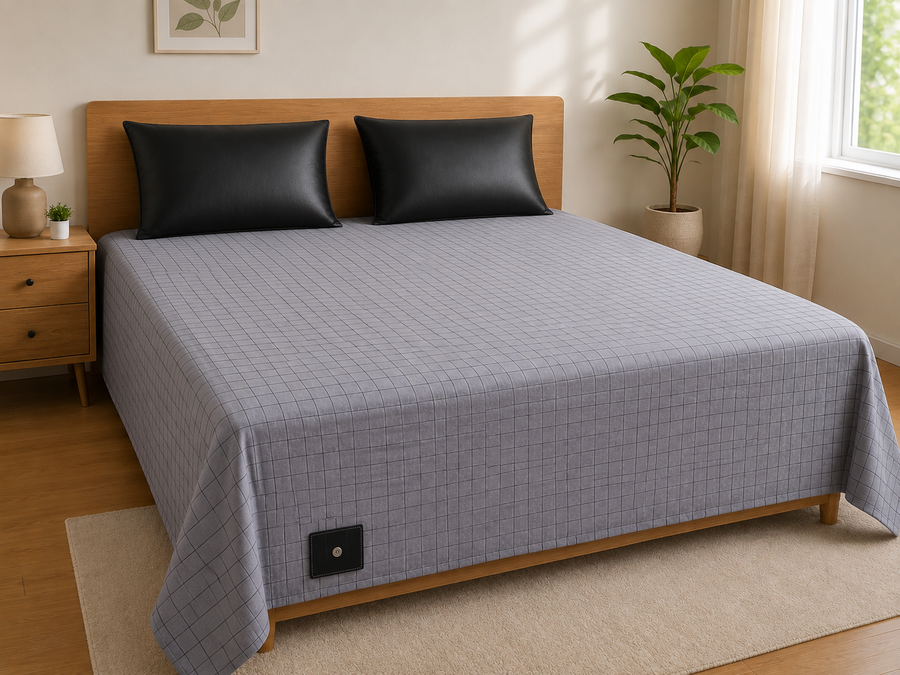
The Tattwas Grounding Bed Sheet uses a genuinely different material to our mat or pillow cover — woven organic cotton threaded with pure silver-coated fibre, built to cover far more of your body than either, for as long as you're actually asleep.
The Tattwas Grounding Bed Sheet · Organic Cotton + Pure Silver-Fibre Thread · Same Grounding Kit as the Rest of the Range · Machine Washable
Rs. 5,399
MRP Rs. 6,999
22% OFF
Add to Basket
99.9%purity of the silver coating on the conductive thread core
~5%silver-fibre ratio — the industry-consensus range for reliable conductivity
Whole-bodycontact area — far larger than a mat or pillow cover alone
In the box: Grounding half-sheet · Grounding cord with 100k-ohm safety resistor · Socket tester · Continuity (earth) tester · Setup & care booklet
02 · Key benefits
Six reasons this format is the one people keep using.
Everything below follows from one fact: a sheet is the only grounding format that stays in contact with you for the entire time you're asleep, no matter how much you move.
The largest contact area in the range
Back, legs and arms rather than feet only or head only — the widest possible margin for error.
Works for a full night, not a session
Six to eight hours of contact while you sleep, with nothing to remember, hold or sit on.
Survives repositioning
Roll, turn, draw your knees up — the conductive grid runs through the whole sheet, so contact holds.
Purpose-built material
99.9% pure silver-coated thread woven into organic cotton — soft and breathable, not rubber or PU.
Machine washable
Care matches ordinary bedding — and washing is exactly what keeps the silver conducting.
Verifiable, every time
Socket tester and continuity tester included, so you can confirm it's working rather than assume.
Stated honestly: the sheet does not deliver a "stronger" grounding effect than our mat or pillow cover. The underlying mechanism is identical across all three. What differs is coverage and duration — which is what makes it the more dependable choice for most people, most nights.
03 · Why an earthing bed sheet
The problem, put plainly: we stopped touching the ground.
For almost all of human history, skin met earth for hours a day — bare feet on soil, sitting on the ground, sleeping close to it. The earth's surface holds a limitless supply of free electrons, and direct skin contact allows your body to settle to the same electrical potential as the ground beneath it.
Three ordinary modern things ended that contact almost completely — and none of them are going away.
Rubber and plastic soles
Leather and hide once conducted. Modern synthetic soles are excellent insulators — they break contact the moment you put shoes on.
Insulated floors, insulated beds
Vinyl, laminate, carpet, foam mattresses and raised bed frames all sit between you and the earth for the majority of the day and all night.
Lives lived indoors and upstairs
Apartments, offices, vehicles. Many people go weeks without their skin touching bare ground for more than a few seconds.
And why not a mat or pillow cover?
Both work — we make both. But both share the same practical limit: they ground one small part of you, and only while that part stays put. A foot mat stops working when you stand up. A pillow cover stops working when you turn away from it.
People change position many times a night without ever waking up. A sheet is the only format that follows you through that.
The third format, in one line
- Mat — Feet · daytime
- Pillow cover — Head/neck · overnight
- Bed sheet — Whole body · overnight
A bed sheet asks for something the mat never did: soft enough for a full night of skin contact, breathable enough not to trap heat, washable like any other bedding. — Tattwas Materials Brief
04 · How it works
A conductor woven through — and a wire to the earth itself.

Outlet ground pin → 100k Ω safety resistor → silver-fibre grid woven through cotton → skin contact. Body at earth potential.
The mechanism
Grounding works by potential equalization. Connect your skin to the earth through a conductor and your body settles to the same electrical potential as the ground — measurable, immediate, and detectable simultaneously at points far apart on the body. It is a physical connection, not a field, a frequency or a charge being "added" to you.
The mechanism is identical across our mat, pillow cover and sheet. Only the surface area and the duration change.
What "silver fibre" actually is
Nylon core
Structural — gives the thread flexibility and tensile strength for weaving
99.9% silver coating
Functional — carries the conductivity that makes grounding possible
Organic cotton base
Comfort and structure — the bulk of the sheet's softness and breathability
Silver is used rather than copper or steel because it has the highest electrical conductivity of any metal — and because, unlike bare copper, silver's own tarnish layer remains conductive rather than insulating.
05 · Benefits backed by research
What the studies actually found — and what they don't claim.
Sample sizes in this field are small and more research is needed — we'd rather say that here than have you find it out later.
Cortisol rhythm normalised over eight weeks of grounded sleep
Participants sleeping grounded showed 24-hour cortisol profiles moving towards a normal curve, alongside self-reported improvements in sleep, pain and stress.
Sleep & cortisol2.7× increase in zeta potential after two hours grounded
Red blood cells showed greater surface charge and less clumping — a measure related to how easily blood flows.
Blood viscosityWhole-body effect, measured at distant points at once
A double-blind study measuring potential simultaneously at multiple points on the body — evidence that the effect is systemic rather than local to the contact point.
Bioelectrical mechanismThe Tattwas Grounding Bed Sheet is a wellness accessory, not a medical device. It is not intended to diagnose, treat, cure or prevent any disease. Nothing above should be read as a promise of a clinical outcome for any individual.
06 · Why choose Tattwas
More silver isn't automatically better. Here's the honest trade-off.
Grounding sheets on the market range from roughly 3% to 20% silver fibre. A bigger number looks better on a listing page, but it isn't simply "more effective" — past a point it buys conductivity you don't need at the cost of softness and price.
| Silver content | What it means in practice |
|---|---|
| Under 3% | Risk of inconsistent conductivity across the full sheet — not recommended at any price |
| 3–5% · Tattwas | Industry-consensus range — reliable conductivity with the best comfort-to-performance balance |
| 10% and above | Excellent conductivity, but increases cost and firmness and reduces the softness a sheet needs |
Look for 3% to 5% silver fibre. Anything less may not conduct consistently across the whole bed; anything more drives up price and reduces comfort. — Summarising independent conductive-bedding buying guidance
How the three formats compare
| Earthing mat | Pillow cover | Bed sheet | |
|---|---|---|---|
| Material | Conductive rubber / PU | Same rubber / PU | Cotton + silver fibre |
| Contact area | Feet only | Head and neck only | Back, legs, arms |
| Through repositioning | Lost when you stand | Lost when you turn away | Held across most positions |
| Typical use | Desk work, seated | Overnight, steady sleepers | Overnight, any position |
| Care | Wipe clean | Wipe clean | Machine washable |
200–400 thread count
High enough for genuine softness, not so high that it buries the conductive grid.
Built-in safety resistor
A 100k-ohm current-limiting resistor sits in the grounding cord as standard.
Two testers included
Socket tester and continuity tester — the same kit shipped with every product in the range.
07 · How to use
Set it up once. After that it just lives on your bed.
1
Test your outlet
Plug in the included socket tester and confirm the outlet is correctly earthed before connecting anything. If it isn't, use a dedicated earth rod instead — never assume the wiring is sound.
2
Position the sheet
Lay it across the section of the mattress your skin contacts most — typically mid-torso to knee. It goes directly under you, with no blanket or top sheet in between.
3
Connect and verify
Snap the grounding cord onto the sheet's stud connector, plug the other end into the ground pin, then confirm a green light on the continuity tester.
4
Sleep as normal
No special position is required. Any bare skin touching the conductive grid is enough — an arm, a calf, the small of your back.
What if my home isn't properly earthed?
The included socket tester will tell you. If the outlet fails, don't use it — connect to a dedicated earth rod driven into soil outside instead.
Should I use this if I have a pacemaker?
Speak to your doctor first. The same applies if you have a known silver or nylon sensitivity. This is a wellness accessory, not a treatment, and it shouldn't replace medical advice.
Care — and why it isn't optional
Silver's one real weakness is worth stating plainly rather than glossing over: it tarnishes on contact with sulfur compounds, which are present in sweat and in many skincare products. Tarnished silver conducts less well than clean silver — the same darkening you'd see on silverware left in a drawer. Washing removes that buildup and restores conductivity. It is maintenance, not housekeeping.
Weekly
Machine wash cold on a gentle cycle with a mild detergent. Air dry where possible. This is what keeps the silver thread conducting.
Always
Skip fabric softener and bleach entirely — softener coats fibres and can insulate the conductive thread. No hot water, no tumble dry on high.
Monthly
Re-check with the continuity tester to confirm nothing has degraded, and re-test the outlet after any electrical work at home.
A related reason we chose ~5% over 3%. A sheet with the bare minimum silver has far less margin before normal, expected tarnish starts affecting performance. More conductive material overall means more tolerance for everyday use between washes.
Rs. 5,399
MRP Rs. 6,999
22% OFF
Add to Basket09 · Frequently asked questions
The questions people actually ask before they buy.
Does it need electricity to work?
No. The sheet draws nothing from the socket. It connects only to the round ground pin, which is a physical wire to the earth, not a power supply.
Is it safe to sleep on a wire connected to a socket?
The cord contains a 100k-ohm current-limiting resistor as a standard safety measure, and the ground pin carries no supply voltage. Test the outlet first, every time.
What if my home isn't properly earthed?
The included socket tester will tell you. If the outlet fails, don't use it — connect to a dedicated earth rod driven into soil outside instead.
Do I have to sleep on bare skin?
Some bare skin needs to touch the conductive grid — a calf, forearm or the small of your back is plenty. Full-body bare skin isn't required.
Can I put a mattress protector over it?
No. Anything between your skin and the sheet — including a top sheet or protector — breaks the conductive path. It goes directly against you.
How long before I notice anything?
Honestly, it varies, and some people notice nothing. The eight-week cortisol study is the clearest published timeline we can point to. We'd rather you judge over weeks than one night.
Why silver instead of copper?
Silver has the highest electrical conductivity of any metal, and its tarnish layer stays conductive. Copper oxide insulates, so a tarnished copper thread loses performance faster.
Will the silver turn my skin or sheets grey?
The silver is bonded to a nylon core inside a woven textile, not loose particles. Normal darkening of the thread itself over time is tarnish, and washing removes it.
How often does it need washing?
Weekly, cold, gentle cycle, mild detergent, no fabric softener. This is functional maintenance — it restores conductivity, not just freshness.
How long does the sheet last?
Lifespan depends on wash care and skin contact chemistry. Use the continuity tester monthly; when it no longer reads green after a wash, the sheet has reached the end of its useful life.
Can two people share one sheet?
Yes, on a shared bed both people are in contact with the same conductive grid, provided the sheet is wide enough for the mattress size chosen.
Should I use this if I have a pacemaker?
Speak to your doctor first. The same applies if you have a known silver or nylon sensitivity. This is a wellness accessory, not a treatment, and it shouldn't replace medical advice.
I already own the mat. Do I need this too?
Not necessarily. The mechanism is the same. The sheet gives more coverage for longer — useful if you move a lot in your sleep, unnecessary if the mat already suits you.
10 · Scientific evidence
The evidence
Sleep, cortisol and grounded sleep over eight weeks
Twelve participants with sleep disturbance and pain slept grounded for eight weeks. 24-hour cortisol profiles moved towards a normalised rhythm, with self-reported improvement in sleep, pain and stress. Small sample — indicative, not definitive. Ghaly M, Teplitz D. (2004). The biologic effects of grounding the human body during sleep. Journal of Alternative and Complementary Medicine, 10(5):767–776.
Blood viscosity and zeta potential
Chevalier G, Sinatra ST, Oschman JL, Delany RM. Earthing (grounding) the human body reduces blood viscosity — a major factor in cardiovascular disease. Journal of Alternative and Complementary Medicine.
Multi-point body potential equalization — double-blind
Sokal K, Sokal P. (2012). Earthing the human organism influences bioelectrical processes. Journal of Alternative and Complementary Medicine.
Conductive silver-fibre thread manufacturing standards
99.9% pure silver electroplated onto a nylon fibre core — conductive textile industry documentation.
Grounding sheet composition standards, 3–20% silver fibre
Comparative industry buying guides on silver-to-cotton ratios and their effect on conductivity, cost and hand-feel.
Silver tarnish chemistry and textile conductivity
Sulfur-compound reaction mechanism and the conductive nature of silver sulfide relative to copper oxide — general materials science.
100k-ohm current-limiting resistor design
Standard safety specification for grounding cord assemblies across the grounding-bedding industry.
Grounding research is an emerging field. Sample sizes are generally small and several key studies share authors. We cite what exists, describe it accurately, and don't extrapolate beyond it.
Shipping, returns and replacements: see our Shipping & Replacement Policy.
Wherever you roll to, you're still grounded.
The Tattwas Grounding Bed Sheet uses a genuinely different material to our mat or pillow cover — woven organic cotton threaded with pure silver-coated fibre, built to cover far more of your body than either, for as long as you're actually asleep.
Add to BasketThe Tattwas Grounding Bed Sheet is a wellness accessory, not a medical device, and is not intended to diagnose, treat, cure or prevent any disease. Individual experience varies. See our Earthing Mat and Grounding Pillow Cover dossiers for the full, extended evidence pack shared across this product family.