

Brand & product dossier · Rooted in Ayurveda · Validated by science
One plate. Pure copper. Water the way nature intended.
Rest it in your matka, dispenser, or storage vessel overnight, and turn ordinary drinking water into Tamra Jal — the copper-enriched water Indian households have trusted for three thousand years.
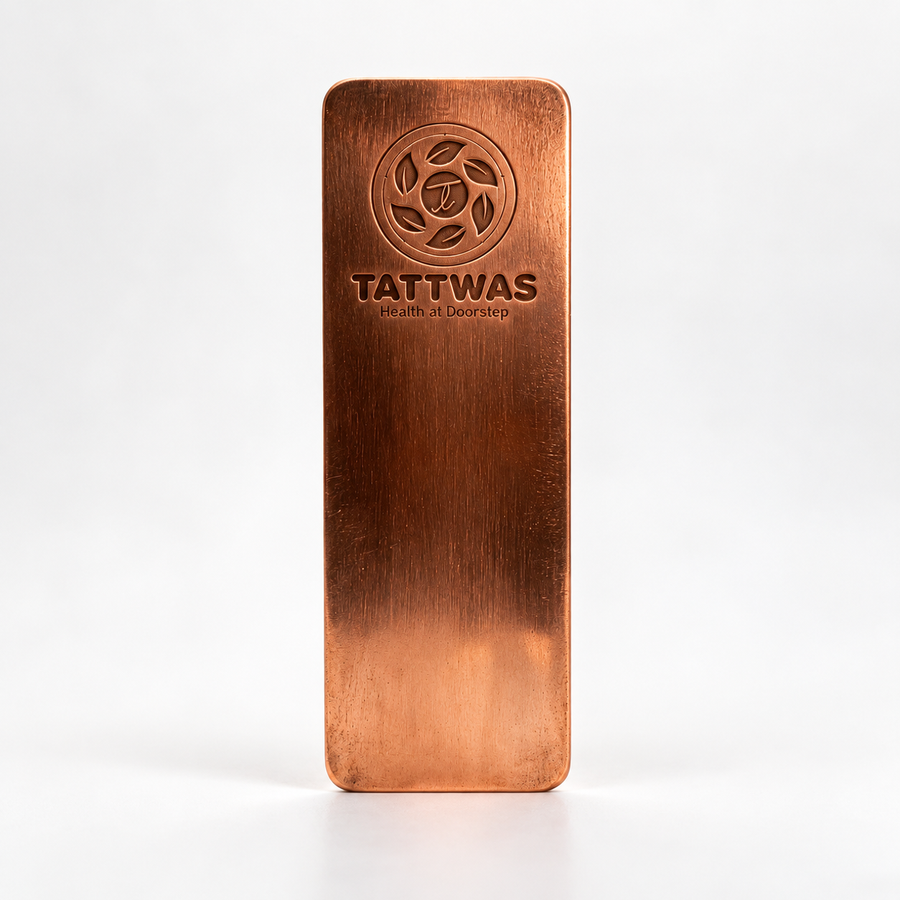
The Tattwas Copper Plate · 11.8 in · 225 g · 99.97% Pure Copper · Made in India — Safety-first dosing · Peer-reviewed evidence · Edition 2
Rs. 1,499
MRP Rs. 1,999
25% OFF
Add to Basket
01 · The problem
Modern water is clean. But is it alive?
RO and UV purification made our water safe — and in doing so, stripped away the trace minerals our bodies evolved alongside. What reaches your glass today is often “dead” water: purified of contaminants, but also of character.
Our ancestors solved this centuries before the RO membrane existed. They didn’t have lab reports. They had copper — and the lived wisdom that water resting in it simply worked better. Today, science has caught up with the tradition.
02 · The philosophy
Water is not just water. It is a Tattwa.
Ayurveda holds that all creation arises from five Tattwas — Prithvi (earth), Jal (water), Agni (fire), Vayu (air), and Akash (space). Among them, Jal is the great carrier: it moves nourishment, energy, and vitality through every cell.
The classical texts — the Charaka Samhita and Sushruta Samhita — describe resting drinking water in copper as Tamra Jal Sevan, prescribed for:
- Agni Deepan — kindling the digestive fire
- Tridosha Samya — harmonising Vata, Pitta, and Kapha
- Nitya Shuddhi — gentle, everyday inner cleansing
Tattwas revives this ritual — not as a bottle for one, but as a plate for the whole home.
03 · The product
The quiet worker at the bottom of your vessel
A solid plate of 99.97% pure, uncoated copper — 11.8 in long, 3.2 in wide, a substantial 225 grams. Drop it into your matka, water dispenser, filter tank, or steel drum. Overnight, it does what copper has done for millennia. No electricity. No cartridges. No plastic.
🔶
99.97% Pure Copper
Uncoated, unpolished, unadulterated.
🏺
Fits Any Vessel
Matka, dispenser, filter tank, or drum.
👨👩👧👦
Family-Scale
Best in a 10–15 L vessel, 8–12 hour rest.
♾️
Lasts for Years
A one-time purchase, never a refill.
04 · Why a plate, not a bottle
Bottles serve one. Tattwas serves everyone.
A copper bottle is a lovely personal habit — one litre, one person, with a narrow neck that’s a chore to clean. But your family drinks from the shared kitchen vessel.
| Feature | Copper Bottle | Copper Stem | Tattwas Plate |
|---|---|---|---|
| Volume enriched | ~1 L | ~1 L | 10–15 L |
| Serves the whole family | ✗ | ✗ | ✓ |
| Keep your existing vessel | ✗ | ✓ | ✓ |
| Easy to clean | ✗ | ✓ | ✓ wipe flat |
| Infusion surface area | Medium | Small | Largest |
The plate’s broad, flat surface means even, efficient infusion across large volumes — the whole household’s daily water, enriched in a single overnight rest.
How it sits in your vessel
One plate. Every vessel. Measured.
It is one fixed plate — 11.8 inches tall — so it sits fully inside a large vessel and stands taller than a small one. More water dilutes the copper, so a larger vessel and a sensible soak time keep every reading comfortably within safe limits.

5 L · 10 L · 15 L — the same 11.8-inch plate shown to scale in three common household vessels.
Estimated dissolved copper · mg/L · by vessel size & soak time
| Soak time | 5 L | 10 L | 15 L |
|---|---|---|---|
| 1 hour * | 0.10–0.25 | 0.05–0.12 | 0.03–0.08 |
| 4 hours | 0.20–0.50 | 0.10–0.25 | 0.07–0.17 |
| 8 hours | 0.40–0.90 | 0.20–0.45 | 0.13–0.30 |
| 12 hours | 0.50–1.20 | 0.25–0.60 | 0.17–0.40 |
| 16 hours | 0.60–1.50 ⚠ | 0.30–0.75 | 0.20–0.50 |
Green rows are the recommended zone — comfortably below limits. On the amber row the top of the range reaches the EPA action level (1.3 mg/L) — avoid. Research-based engineering estimates for the Tattwas plate (11.8 × 3.2 × 0.04 inches, 225 grams) in neutral drinking water — estimates only, not laboratory measurements. Thresholds: EPA action level 1.3 mg/L · WHO guideline 2.0 mg/L · bitter taste approximately 2.5 mg/L. * One-hour values are extrapolated from the four-to-sixteen-hour trend; the source data begins at four hours.
05 · The ritual
Three steps to Tamra Jal
1
Place
Rinse the plate and lay it flat at the bottom of a clean 10–15 L vessel.
2
Rest 8–12 hours
Let the water sit undisturbed overnight. Copper ions release slowly and steadily.
3
Pour & begin
Start every morning with naturally enriched water — for everyone at the table.
06 · The science — tradition, proven
We don’t ask you to take it on faith.
Copper’s effect on water isn’t folklore — it is one of the most studied traditional practices in modern microbiology.
“Water contaminated with cholera, E. coli and Salmonella, then stored in copper for 16 hours, yielded no recoverable live bacteria.” — Sudha et al. (2012), Journal of Health, Population & Nutrition · NIH / PMC3312355
~90%reduction in coliform bacteria versus steel & plastic vessels
16 hoursto eliminate diarrhoea-causing bacteria at room temperature
2.0mg/L — the WHO safe ceiling. Tattwas stays far below it.
Copper’s antimicrobial action — the oligodynamic effect — is the same reason hospitals fit copper-alloy handles and rails: microbes are highly sensitive to copper, while human tissue tolerates it well.
07 · The numbers — honest estimates
Measured thinking, not marketing hype.
Research-based engineering estimates for the Tattwas plate (11.8 × 3.2 × 0.04 in, 225 g) in neutral drinking water — checked against the international safety ceilings.
Where Tattwas sits on the global safety scale (mg/L)
0.13 – 0.60Tattwas recommended use (10–15 L · 8–12 hours)
1.30US EPA action level
2.00WHO drinking-water guideline
Recommended use sits at roughly one-quarter of the WHO limit. Copper turns water noticeably bitter above ~2.5 mg/L — a natural warning long before any risk.
Estimated dissolved copper concentration (mg/L · ppm)
| Resting time | 5 L vessel | 10 L vessel | 15 L vessel |
|---|---|---|---|
| 4 hours | 0.20–0.50 | 0.10–0.25 | 0.07–0.17 |
| 8 hours | 0.40–0.90 | 0.20–0.45 | 0.13–0.30 |
| 12 hours | 0.50–1.20 | 0.25–0.60 | 0.17–0.40 |
| 16 hours | 0.60–1.50 ⚠ | 0.30–0.75 | 0.20–0.50 |
Recommended use
A 10–15 litre vessel, rested 8–12 hours. This delivers roughly 0.13–0.60 mg of copper per litre — comfortably inside every international drinking-water guideline, while still meaningfully enriching the water. For a 5 L vessel, limit the rest to 8 hours.
Green marks the recommended zone. Amber marks an extended soak in a small vessel — limit 5 L vessels to 8 hours.
Figures are research-based estimates for a plate of these dimensions in neutral drinking water; actual values vary with water chemistry, temperature, and vessel material. Not laboratory measurements of this specific unit.
Rs. 1,499
MRP Rs. 1,999
25% OFF
Add the Copper PlateOne plate, one vessel — enriches 10–15 L overnight.
08 · Safety & suitability
We’ll also tell you when not to use it.
Copper is an essential mineral — not a health drink. Part of using it well is knowing the limits. No other brand will tell you this. We will.
⛔ Do not use
Wilson’s disease
A genetic disorder in which the body cannot excrete copper, causing it to accumulate in the liver and brain. Anyone diagnosed with Wilson’s — or on copper-chelation therapy — must strictly avoid copper-enriched water.
Infants under 1 year
Never prepare formula or feed a baby with copper-enriched water. An infant’s liver cannot yet regulate copper, and infant copper exposure has been linked to childhood liver disease. Use plain boiled or filtered water.
🩺 Consult your doctor first
Liver conditions — cirrhosis, hepatitis, fatty liver
The liver clears copper from the body; if impaired, copper can accumulate.
Chronic kidney disease, or a family history of Wilson’s disease
Speak to your doctor before making copper-enriched water a daily habit.
Toddlers and young children (1–5 years)
Their safe upper limit is far lower than an adult’s — as little as 1 mg/day for ages 1–3. Give in moderation; never as their only water.
Pregnancy and breastfeeding
Copper needs are in fact higher (1.0–1.3 mg/day) — but confirm with your doctor.
If you take a copper supplement or a multivitamin containing copper
It all adds up. Check your total intake.
The real risk is misuse, not moderate use
| ❌ Never do this | Why it matters |
|---|---|
| Use with lemon, buttermilk, juice or soda | Acid strips copper from the plate aggressively. |
| Use with hot water | Heat sharply accelerates copper release. |
| Leave a green or blue-green crust on the plate | That crust — verdigris — is the compound that actually causes copper poisoning. Scrub it off. |
| Soak far beyond 12 hours in a small vessel | Concentration keeps climbing with time. |
| Drink copper water exclusively, all day, forever | Ayurveda prescribes it as a ritual, not a replacement for all water. |
👅 Your body has a built-in warning
Copper turns water bitter or metallic above roughly 2.5 mg/L. If your water tastes metallic, it is too concentrated — shorten the soak, use a larger vessel, or dilute. Trust your tongue.
✅ The safe zone
For a healthy adult using a 10–15 L vessel with an 8–12 hour rest, the water carries roughly 0.13–0.60 mg of copper per litre — well within the WHO guideline of 2.0 mg/L, and a sensible contribution toward the 0.9 mg adult daily copper requirement.
09 · The benefits
What Tamra Jal offers
- Naturally antimicrobial water — copper’s proven action against common waterborne bacteria.
- Supports digestion & metabolic rhythm, per Ayurvedic tradition.
- Contributes to your essential copper intake — vital for energy, iron, and immunity.
- Zero coatings, chemicals, or plastic — one plate replaces years of consumables.
10 · Care ritual
Use · cleanse · repeat
🚿
Daily
Rinse the plate with clean water at each refill.
🍋
Weekly
Rub with lemon & salt (or tamarind — the traditional way), rinse, dry. This is a safety step, not just cosmetic.
👀
Always
A warm brown patina is normal. A green-blue crust is not — scrub it off before use.
11 · Evidence pack · studies & books
The evidence
Everything below is real and verifiable.
Peer-reviewed studies & official standards
1Storing drinking-water in copper pots kills contaminating diarrhoeagenic bacteria
Sudha VB et al. (2012). J. Health, Population & Nutrition 30(1):17–21. The flagship study — no live bacteria recoverable after 16 hours.· Read source →
2Inactivation of E. coli, S. typhi & V. cholerae in copper vessels
Sharan R, Chhibber S, Reed RH (2010–11). Effects of temperature & pH. Establishes the conditions under which copper reliably disinfects.· Read source →
3Antibacterial activity of various water-storing vessels
Preethi S. et al. Indian J. Microbiology Research. Copper versus steel versus plastic — copper showed the significant coliform reduction.· Read source →
4Copper in Drinking-water (Guidelines for Drinking-water Quality)
WHO. The 2.0 mg/L health-based guideline value; bitter taste above ~2.5 mg/L.· Read source →
5Dietary Reference Intakes
Institute of Medicine (NCBI Bookshelf). Copper RDA 900 µg/day; tolerable upper limit 10 mg/day for adults, far lower for children.· Read source →
6Copper — The Nutrition Source
Harvard T.H. Chan School of Public Health. Copper’s role in energy, iron, collagen, brain & immune function.· Read source →
Books on copper & Tamra Jal in Ayurveda
Charaka Samhita & Sushruta Samhita
The classical compendia that originally describe drinking water stored in copper (Tamra Jal).
The Complete Book of Ayurvedic Home Remedies
Dr. Vasant Lad.
Ayurveda: The Science of Self-Healing
Dr. Vasant Lad. Foundational text on the five-element (Tattwa) framework.
Prakriti: Your Ayurvedic Constitution
Dr. Robert Svoboda.
Textbook of Ayurveda
Dr. Vasant Lad. Academic treatment of Ayurvedic elemental theory.
A note on how we use the word “proven”
The antimicrobial water-quality findings (studies 1–3) are peer-reviewed — we say “proven” there and we mean it. The books describe and endorse the tradition, but they are not clinical trials; we present them as traditional and expert references. That distinction is deliberate. A brand that overstates its evidence has already told you what it is worth.
One plate. One vessel. One timeless ritual.
Every family deserves its Tamra Jal. Revived by Tattwas — and honest enough to show you the limits.
Order Your Tattwas PlateTattwas is a wellness product, not a medicine. It does not diagnose, treat, or cure any disease. If you have any medical condition, speak to your doctor.